Job & Services Marketplace Platform
A dual-engine German marketplace platform establishing complete structural isolation between contract employment (CV-based) and independent business services (portfolio-based), engineered with Next.js and secure OAuth architectures.
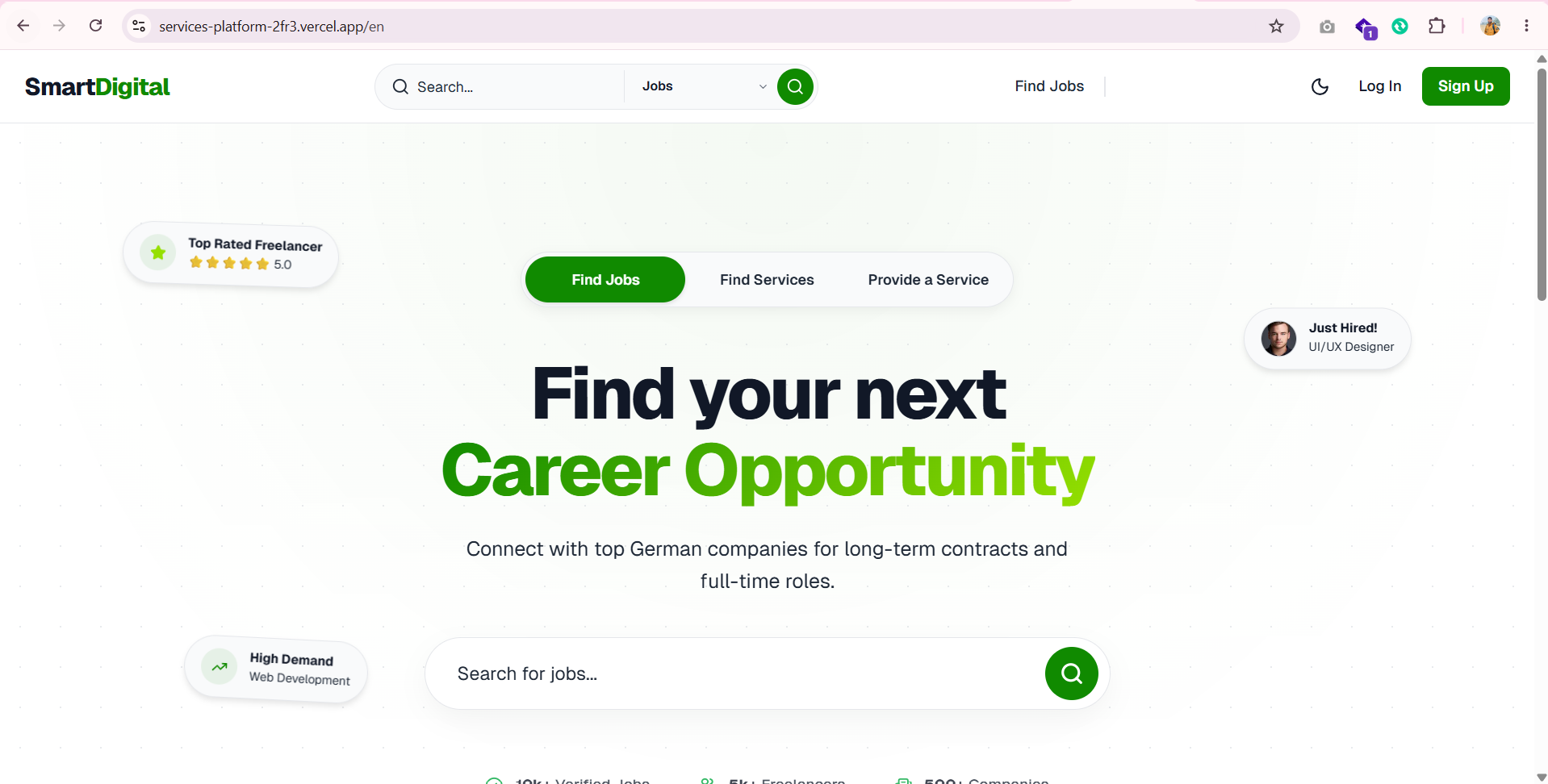
Job & Services Marketplace Platform - Dual-Engine Dual-Market Architecture
Project Overview
This enterprise marketplace application is built specifically to address regulatory and operational differences in the German labor market[cite: 45]. It maintains a strict, unconditional architectural separation between traditional Contract Employment and Independent / Gewerbe services[cite: 56, 57, 58].
The platform features two distinct algorithmic flows: a CV-driven track for workforce recruitment [cite: 92, 97], and a visual portfolio/bidding infrastructure for independent service providers[cite: 98, 102, 103]. Built using a responsive Next.js frontend [cite: 75], the platform supports multi-language operation [cite: 73] and implements federated OAuth entry channels to service thousands of simultaneous users securely[cite: 277, 281].
Key Core Architectures
🌐 The "Two-World" Structural Isolation
- World 1: Contract Employment Engine: Tailored exclusively for traditional recruitment workflows[cite: 79, 92]. It features a programmatic CV Builder that compiles user metrics, structural skill sets, and experience details into dynamic, printable PDF templates[cite: 66, 190, 200]. Traditional applications process automatically under linear submission states (Sent, Viewed, Accepted, Rejected)[cite: 207, 210].
- World 2: Independent / Gewerbe Engine: A freelance bidding marketplace designed for B2B and consumer contract execution[cite: 80, 98]. It replaces text resumés entirely with rich, visual Portfolio Management modules allowing providers to construct case-studies with detailed before/after project imagery[cite: 68, 102, 241, 248].
- Strict Compliance Enforcement: System business rules strictly block data mixing; contract jobs require a valid CV structure [cite: 97, 278], while B2B independent agreements rely entirely on service portfolios[cite: 103, 278].
🔐 Federated Authentication & Identity Verification
- Dual-Provider OAuth 2.0 Integration: Built secure token validation handlers for Google and Facebook login flows[cite: 281, 282, 287].
- Deterministic Account State Linking: Automated account matching filters incoming emails to safely attach third-party authentication tokens to legacy data sets, preventing duplicate account profiles[cite: 286, 288].
- Dynamic Onboarding Guardrails: First-time social media sign-ins register with a safe baseline profile, instantly triggering a dedicated role allocation view (Private Individual, Worker, Company, Service Provider) prior to granting system workspace access[cite: 285, 290, 291].
💬 Real-Time Interactions & Controls
- Bid Negotiation & Chat Matrix: Integrated full 1-to-1 asynchronous messaging pipelines supporting real-time notification states and binary attachments for contracts[cite: 262, 266, 268, 269].
- Anti-Scam & Moderation Desk: Constructed specialized dashboards for system operators to screen companies, monitor portfolio assets, manage category models, and issue instant domain blocks on suspected user accounts[cite: 72, 128, 134, 135, 276].
Detailed Platform User Flow
The application executes identity routing across explicit operational paths:
  [ User Init via OAuth / Pass ]
               │
               ▼
     [ Token Verified? ] ──(No)──► [ Throw Graceful UI Error ]
               │ (Yes)
               ▼
    [ Existing Account? ] ─(No)─► [ Verify Email & Force Account Type Selection ]
               │ (Yes)                                    │
               │                                          ▼
               │                            (Individual / Worker / Company / Provider)
               ▼                                          │
    [ Load Target Workspace Dashboard ] ◄─────────────────┘
Technical Stack
Frontend & Logic: Next.js (App Router Rendering), React, TypeScript, Tailwind CSS, Client Authentication Contexts [cite: 6, 7, 75]
Backend Ecosystem: Node.js REST Route Middlewares, Secure Server Token Handlers, PDF Generation Ingestion Engines [cite: 66, 200, 287]
Data Layers: PostgreSQL Database, Prisma Schema ORM [cite: 8, 279]
Authentication & Security: State Parameter Validation, JWT Token Cryptography, OAuth 2.0 Web SDKs [cite: 277, 282, 287]
Project Execution & Impact
- ✅ Phased Structural Architecture: Feature delivery aligned with a 4-phase milestone roadmap, prioritizing core identity engines followed by media asset management, negotiation tools, and the admin control system[cite: 280].
- ✅ High-Velocity UI Engine: Reached optimized time-to-interactive benchmarks allowing sub-2s responsive page transitions across target mobile devices[cite: 277, 278].
- ✅ Internationalized Localization Ecosystem: Implemented native structural multi-language engines serving localized parameters for English, German, Romanian, and Russian user bases[cite: 73, 278].